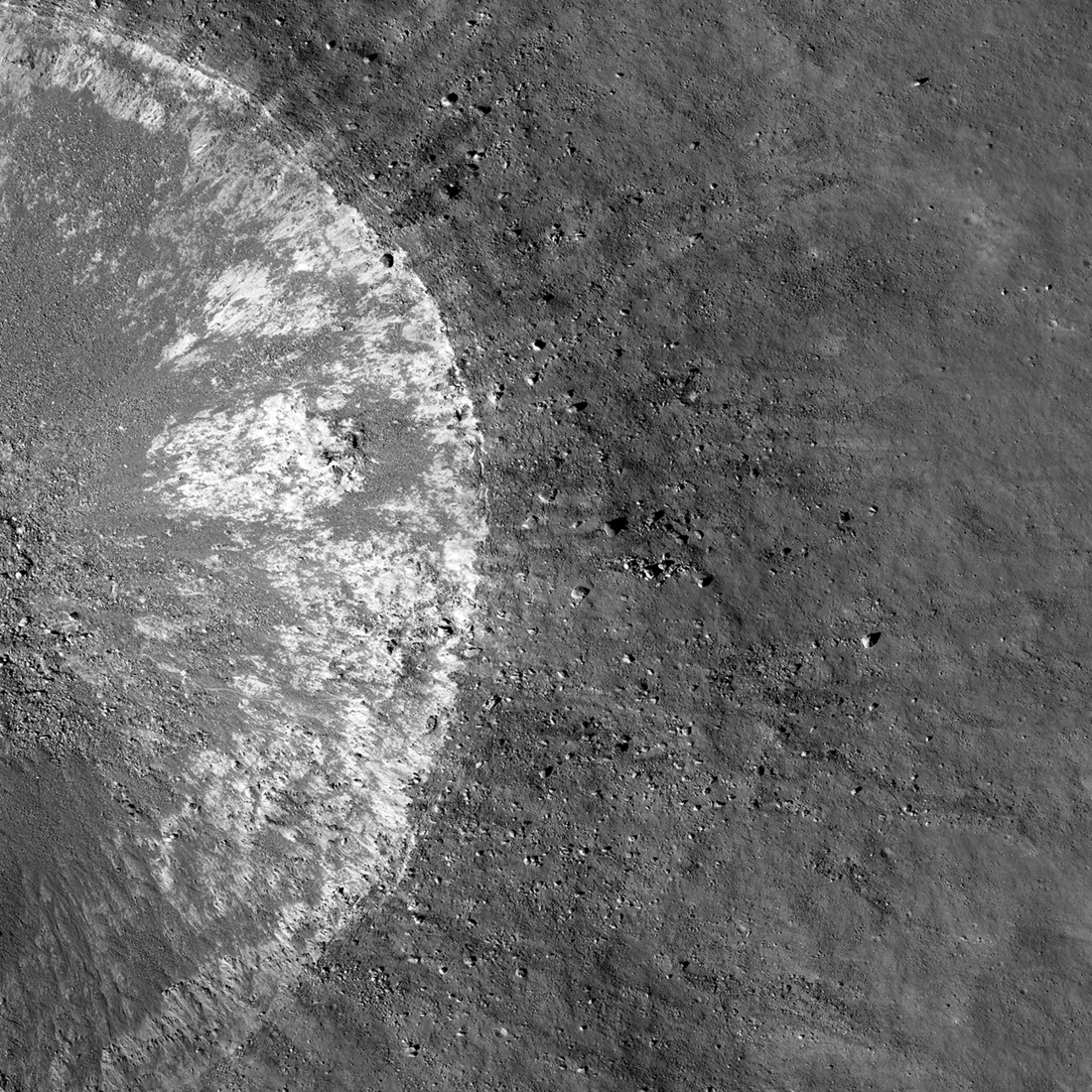
When an asteroid or comet strikes the Moon at hypervelocity (>10 kilometers per second), it first buries itself deeply before exploding with tremendous force; the explosion lifts and ejects a large volume of material, spreading debris around the crater. For example, around Posidonius Y (1950-meter diameter, 480 meters deep, 30.033°N, 24.908°E), the blocky ejecta is clearly visible, and the largest boulder, measuring about 25 meters by 20 meters and likely 10 meters tall, weighs more than 10,000 metric tons. When observing the number of boulders, imagine the immense forces required to blast them from depths of more than 100 meters. Full resolution look at the rim of Posidonius crater. The image is 1825 meters wide (M168041107LR), acquired on 15 August 2011 [NASA/GSFC/Arizona State University].
Related Featured Images
Concentric Crater With Blocky Ejecta
Boulder Tracks: Race to the Bottom of Chaplygin Crater!
Published by Mark Robinson on 11 May 2026